
This self-directed eLearning Module looks at STEM identity and how adults can foster its development among youth. Explore strategies that connect STEM to everyday life, strategies to highlight the social impact of STEM, and ways to share personal stories of STEM professionals.
Language: English
This self-directed eLearning Module lays the foundation for why it is important to engage girls with STEM. Learn how to address issues of unconscious bias and gain tips for engaging young women, as well as young men, from traditionally marginalized backgrounds who are under-represented in the STEM sector.
Additional Languages
Ignite Activities are short, typically 5 to 15 minutes to complete, hands-on activities that use everyday materials to excite youth interest in STEM2D. Ignite activities are available in Chinese, English, French, German, Indonesian, Italian, Portuguese, and Spanish.
NIWL developed 25+ classroom-based STEM student activities. These activities are centered on inquiry-based investigations and hands-on learning and integrate student-centered learning principles such as collaboration and teamwork. Check out the STEM²D Student Activities Series Overview and then choose from any of the activities to bring STEM to life in your classroom!

This 3-5 minute online quiz helps young people explore their interests and how a career in STEM can make a difference in the world.
This self-directed eLearning Module explores youth development — the growth process by which all young people seek ways to meet their basic physical and social needs, adolescent brain development, and Positive Youth Development — an approach to build competencies that are necessary to succeed in adolescence and adulthood.
Additional Languages

Over 4,000 students and countless volunteers have passed through BTE over our 25 years. We have collected their stories and distilled lessons from them for the future of the program.
In honor of BTE’s 25th Anniversary, we conducted a study to isolate 25 lessons from BTE program implementation. This report illustrates our findings.
Motivated by low academic achievement and the unacceptable number of young people leaving school before graduation, Johnson & Johnson established its Bridge to Employment (BTE) initiative in 1992. Written to coincide with BTE’s 20th anniversary, this report takes a look at BTE’s timeline, model, and some individual success stories.
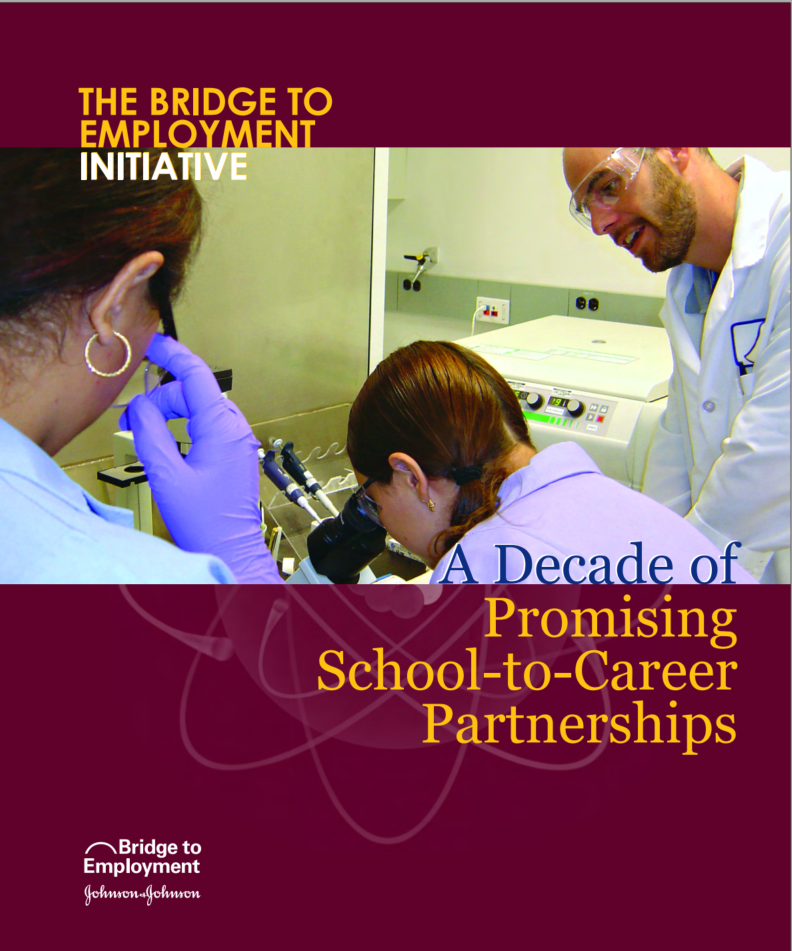
Johnson & Johnson’s highly successful Bridge to Employment (BTE) initiative stems from the use of a common core of scientifically sound school-to-career principles: maintaining high standards of academic learning for all students; providing opportunities for contextual learning; creating links with institutions of higher education; and connecting students with adults in the workplace. This publication explores these and other promising practices.